Net Price Calculator vs. Actual Aid Offer: Why the Numbers Never Match

Typically, the phone starts ringing around the end of March every year.
In October, a family ran the net price calculator. About $22,000, maybe $27,000, seemed like a reasonable amount. They carefully considered how to get around it. The grandchildren were informed. The student's mind began to wander to the student's hostel.
Next, the letter requesting financial assistance came.
The total came to $41,000, or $53,000. Alternatively, as one New Jersey counsellor informed us, it was over $40,000 more than what the calculator had indicated six months prior.
Plus, they contact you.
This happens at virtually every high school counselling office across the United States, every single spring. Not because the families did anything wrong. Not because the calculator is broken, exactly. But because almost nobody explains in plain language, before the letters arrive,
What the net price calculator actually does and what it fundamentally cannot do.
That is the purpose of this post. Share it with families in the fall, before they run any calculators and set any expectations. And if you have not yet seen how AI can help you find the time for conversations like this one, CollegeFind’s post on email workflows is a useful starting point.
What the calculator actually measures and what it cannot
The Higher Education Opportunity Act mandates that all US colleges include a net pricing calculator on their websites. The objective is to furnish families with an estimate of their post-grant and scholarship expenses, predicated on their financial data.
The word estimate is crucial.
Net pricing calculators are based on the average financial aid statistics from the preceding year. They employ standard cases. They are unable to consider your family's particular circumstances in the ways that genuinely influence the figures:
Divorced or separated parents:
The FAFSA Simplification Act changed which parent's income is assessed, but many calculators have not been updated to reflect the new methodology. This change affects a significant number of families across California, Texas, and Florida.
Self-employment income:
Small business owners and freelancers are assessed differently than W-2 employees. The calculator assumes W-2.
Multiple children in college simultaneously:
Under prior FAFSA rules, the situation triggered additional aid. Under current simplified rules, this no longer happens automatically. Families who learned about this benefit from older siblings may still calculate their eligibility based on outdated rules.
Outside scholarships:
At many schools, a student who wins a $3,000 community scholarship may see their institutional grant reduced by the same amount. The calculator shows nothing of this offset.
Medical expenses, business equity, housing equity, and non-standard assets:
None of these nuances exists inside the calculator's model.
The result: the net price calculator is a directional signal, not a planning number. It is useful for comparing schools in a general range. This is dangerous for setting a family budget, which is precisely how most families use it.
We covered the sticker-price myth in depth in our analysis of what 10,000 student college lists revealed about how families actually plan for cost is that the most expensive-sounding schools are often the most affordable once actual net cost is calculated, but that insight only helps if families are comparing the right number.
Three gaps counselors can explain in October, that prevent the March call
Teaching families these three gaps in a fall appointment or parent information night takes ten minutes and prevents most of the spring panic calls. The conversation is the same whether the family is in a suburban Connecticut district or a Title I school in South Texas.

Gap one: The data gap:
The calculator uses last year's data averaged across all aid recipients. If your family's financial profile is unusual, like a significantly above- or below-average income, non-standard family structure, or irregular assets than your actual aid will differ, sometimes by a lot.

Gap two: The front-loading gap:
Many US colleges award more grant aid in Year 1 to attract students and enrolment, then reduce it in Years 2, 3, and 4. The calculator shows only Year 1. Families need to ask, every time, before they commit to a school: "Is this award fully renewable? At what GPA? Does the amount stay the same in all four years?" The answer sometimes changes the entire college decision.
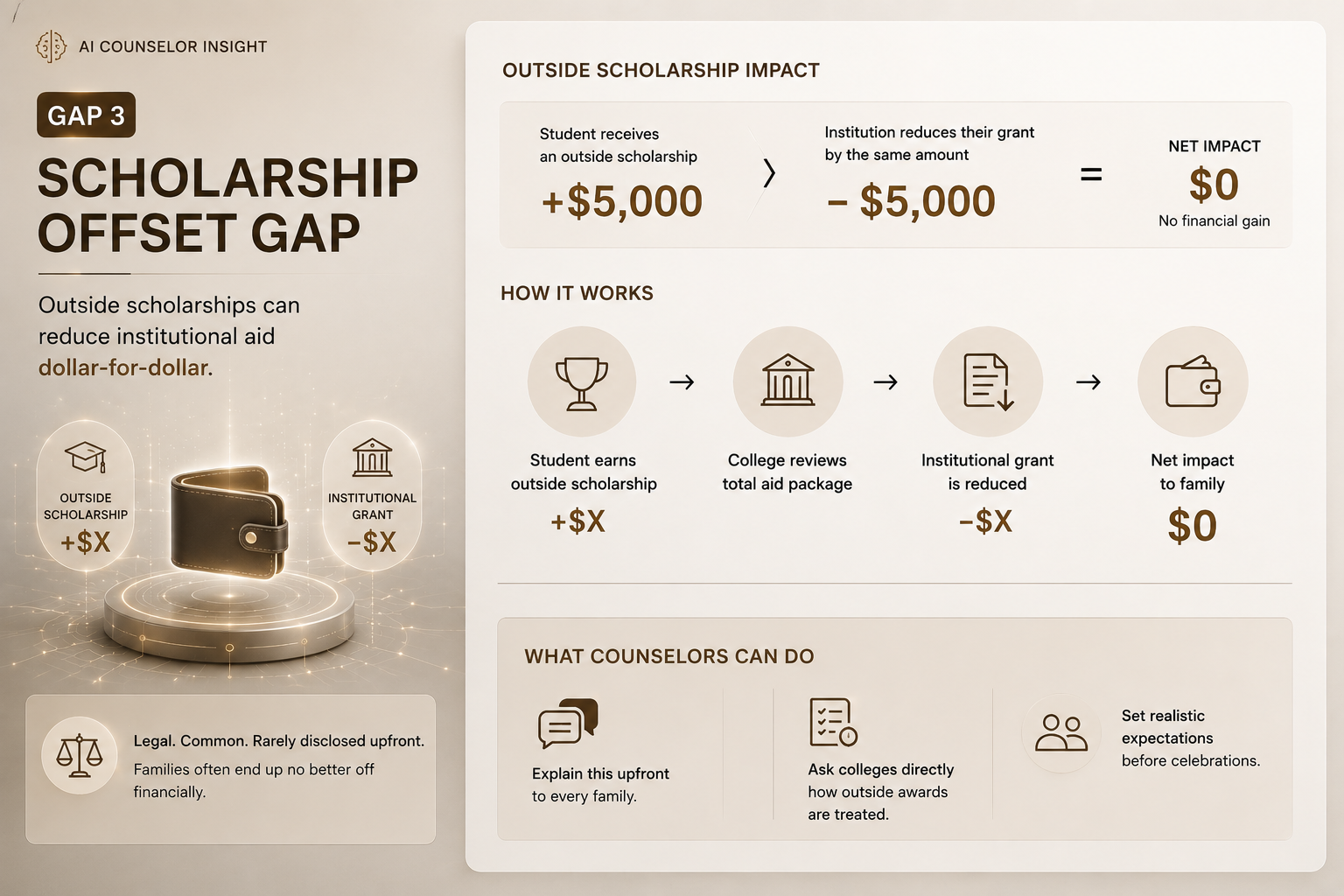
Gap three: The scholarship offset gap:
When a student wins an outside scholarship, a Rotary Club award, a corporate grant, or a community foundation scholarship, many US institutions reduce their own institutional grant by the same amount. The family ends up no better off financially. This practice is legal, common, and almost never disclosed until after the student has already celebrated winning the outside award.
Explaining these three gaps in October instead of March takes the same amount of time for the counsellor. The emotional outcome for the family is entirely different.
What changed in FAFSA 2026–27 that makes this cycle different
The amendments made to the FAFSA Simplification Act have resulted in the introduction of new complexity that is unique to the 2026–27 budget cycle. The majority of institutional net price calculators have not yet been updated to reflect the new technique, although this year saw several asset and income assessment standards come under scrutiny and undergo modifications.
This is significant from a practical standpoint: households whose income or asset profile falls within the new categories may have a discrepancy between their calculator and letter this cycle that is wider than normal. Consider the outputs of the calculator to be directional only for this year. This is something that we should highlight expressly in any autumn communication.
In this section, we go over the whole list of post-FAFSA actions that families are required to do after the form has been submitted, including instructions on how to monitor these specific changes. In today's world, filling out the Free Application for Federal Student Aid (FAFSA) has become the initial step in the process of applying for virtually all forms of financial assistance that are accessible to students.
The professional judgment appeal is the most important thing most US families never hear about
Here is a fact true at virtually every accredited US college and university, from community colleges in California to flagship research universities in New York, that almost no family knows unless a school counselor tells them:
Financial aid offices have professional judgment discretion. Federal law explicitly allows them to adjust a student's aid package if a family can demonstrate that the standard FAFSA assessment does not reflect their actual financial situation.
Common qualifying circumstances:
Job loss or significant income reduction since filing taxes, medical expenses not on the tax return, divorce or separation after FAFSA was filed, death of a primary earner, natural disaster losses, unusual dependent care costs.
The process is called a Professional Judgment Review or Special Circumstances Appeal which requires a letter and supporting documentation. The outcome is not guaranteed. But the potential upside is significant enough, and the cost of not asking is zero, that every eligible family should know this option exists.
Almost no first-generation family in the US knows about this unless a counselor tells them. This is the kind of information that only reaches families through a counselor who has enough time to have a real conversation. Which is why the email workflow tools matter beyond time savings and they are the mechanism for recovering the minutes to have this conversation.
How to compare aid letters correctly: what US counselors should teach every family
When comparing financial aid offers from multiple schools, here is what to look at, not what letters typically show first. Adapt these findings into a one-page handout for families.
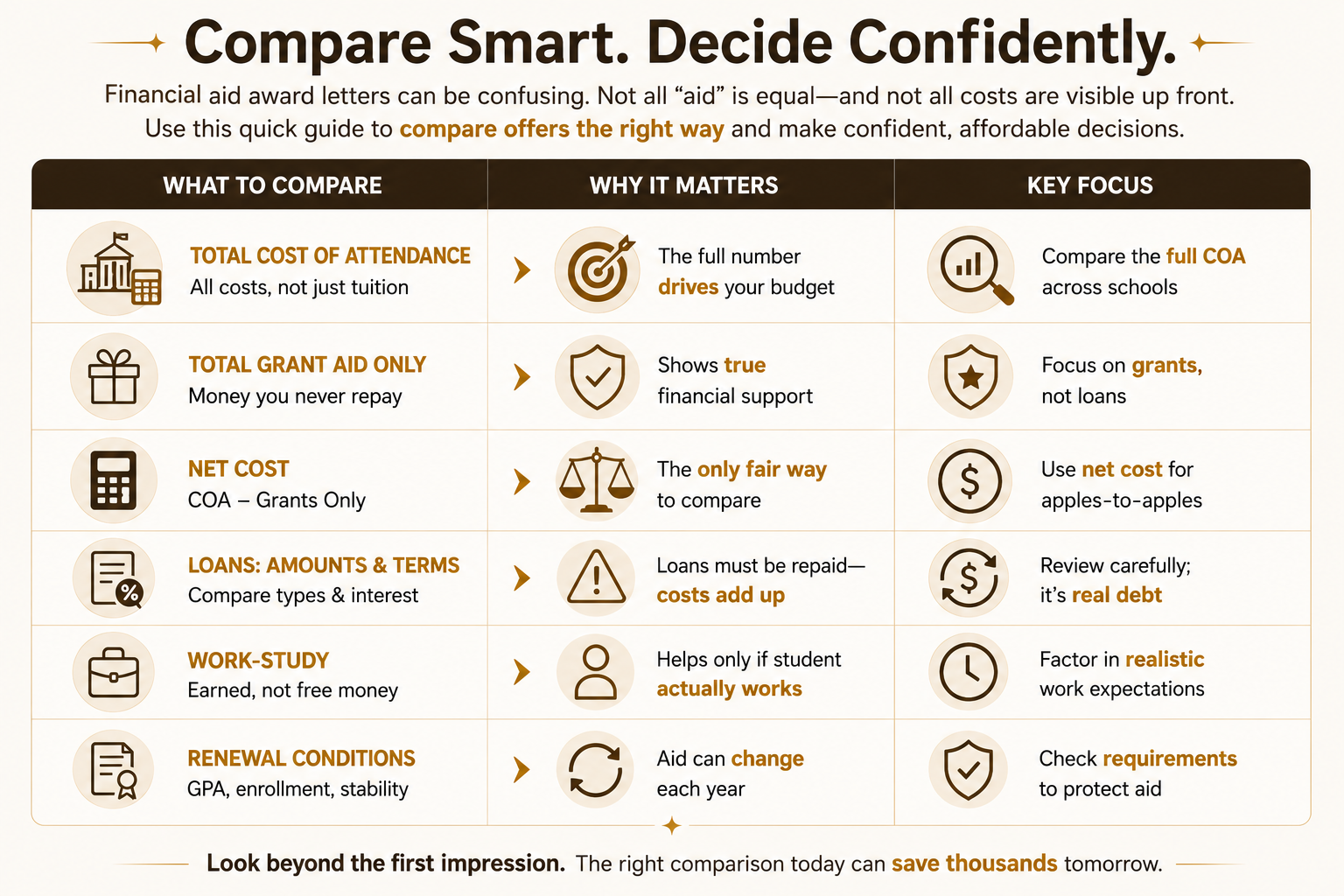
Comparing schools on net cost rather than sticker price or total aid package frequently produces an entirely different financial ranking than the one families started with. Often, the school the family assumed was unaffordable turns out to be the most affordable option on the list.
That insight requires a counselor to explain it. No calculator delivers it automatically.
State-specific financial aid notes for US counselors
California:
DREAM Act state aid is available for eligible undocumented students, many families do not know the program is separate from the FAFSA and requires a separate application through the California Student Aid Commission. UC schools also have significant variation in institutional grant generosity across campuses; UCLA and Berkeley are frequently less affordable than UC Santa Cruz or UC Riverside for families just above the Pell threshold.
Texas:
The Texas Grant program covers most tuition at public universities for eligible students, but is not renewable if a student changes their major in a way that extends their enrolment timeline. This is worth explaining before students commit.
New York:
The Excelsior Scholarship for families earning under $125,000 covers tuition at SUNY and CUNY, but has post-graduation residency requirements that affect students planning to relocate after graduation.
Illinois:
The MAP Grant has one of the earliest effective FAFSA filing deadlines of any US state. Families in Illinois should file as close to the October 1 FAFSA opening as possible to secure MAP funds, this point needs to be made explicitly in fall counselor communications, not assumed.
Florida:
Bright Futures Scholarship tiers are based on weighted GPA and community service hours. Students who needed the Gold Scholarship tier but only tracked Silver-eligible hours throughout high school cannot increase their community service count retroactively. This is a conversation that belongs in 9th grade, not 12th.
Georgia:
The HOPE Scholarship covers significant tuition at Georgia public institutions for students maintaining a 3.0 GPA. For many Georgia families, HOPE effectively makes UGA, Georgia Tech, and Georgia State the most financially accessible four-year options and that should shape the financial floor of every Georgia student's college list, the same principle will be outlined in future post.