School Counselor Ratios 2026: Is Your State Falling Short?
Quick Answer
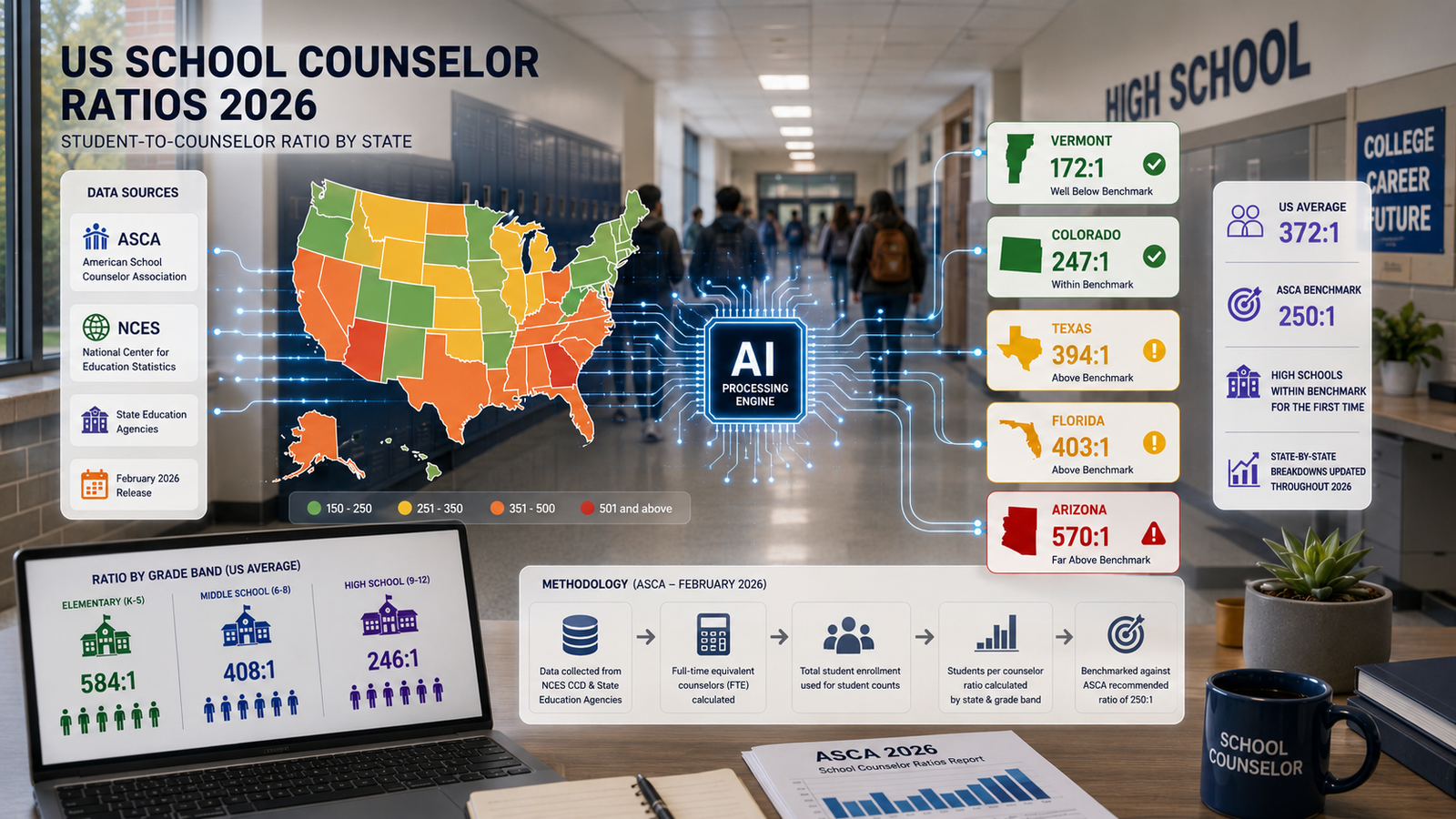
- National student-to-school-counselor ratio (2024–2025): 372:1
- ASCA recommended benchmark: 250:1
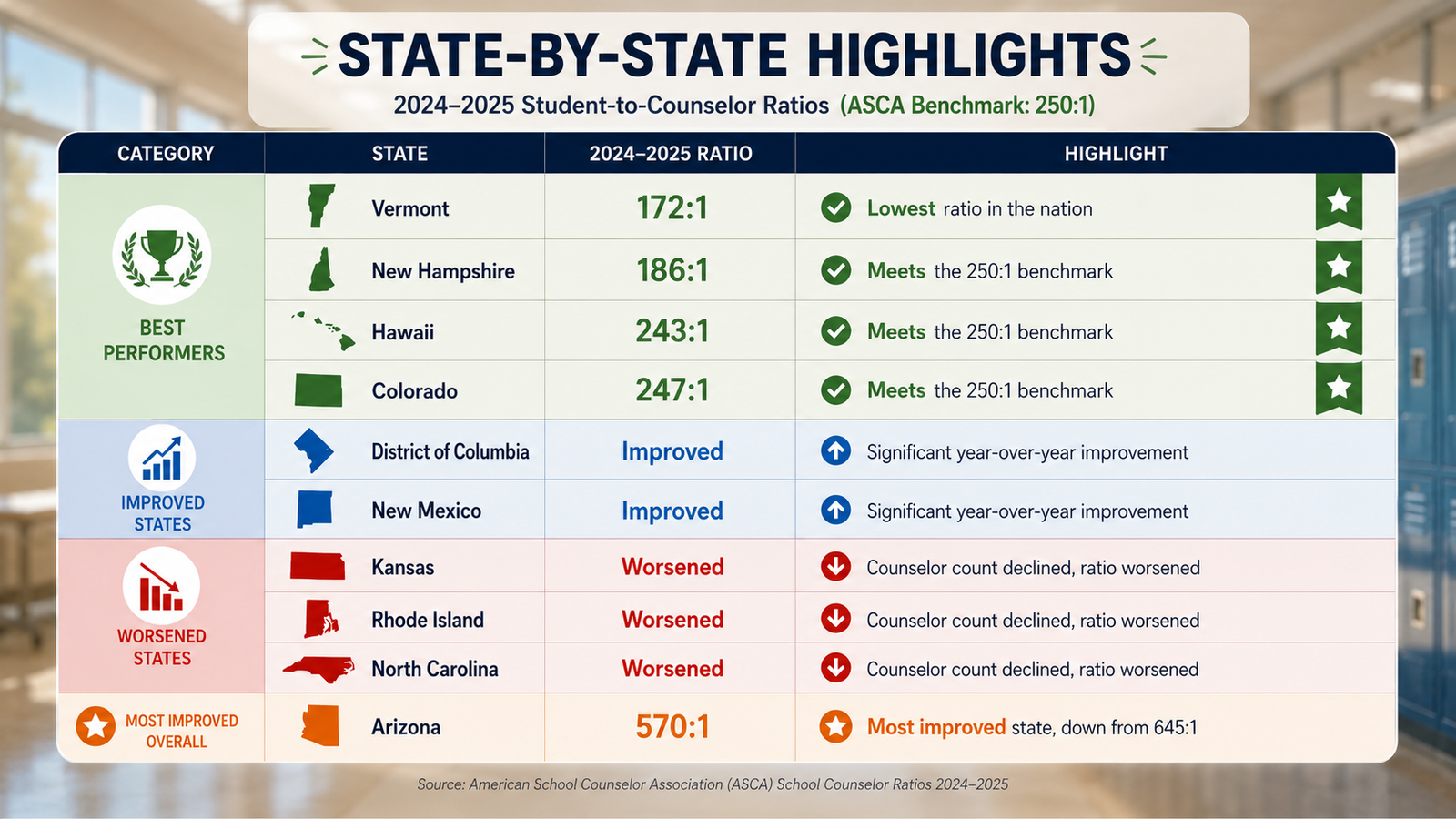
- Most improved state: Arizona, 570:1, down from 645:1
- Lowest ratio in the nation: Vermont
- States meeting the 250:1 benchmark: Colorado (247:1), Hawaii (243:1), New Hampshire (186:1), Vermont (172:1)
- High school range (35 reporting states): 195:1 to 224:1
- Elementary/middle range (35 reporting states): 571:1 to 694:1
Why This Data Matters
Every counseling office conversation is about workload, about AI adoption, and about staffing requests, and it eventually comes back to one number. This page is the canonical reference for that number, where the current US school counselor ratio, broken down by state, by grade band, and against ASCA's own recommended benchmark, is sourced directly from ASCA's February 2026 release and NCES's underlying data.
The National Picture: 2024–2025
That split matters. A national average of 372:1 hides two very different realities: high schools that are, for the first time, adequately staffed by ASCA's own standard and elementary/middle schools that are still three times more overloaded than that.
Ratios by Grade Band
ASCA's 2024–2025 release draws on 35 states that report elementary/middle and secondary counselor counts separately. Within those states:
- High school (grades 9–12): 195:1 to 224:1, the first time this range has fallen within the 250:1 benchmark.
- Elementary/middle (PreK–8): 571:1 to 694:1, still far above the recommended level.
Fifteen states report a single combined counselor count, so exact grade-band ratios aren't available for every jurisdiction.
Methodology
ASCA calculates student-to-school-counselor ratios using data from the U.S. Department of Education's National Center for Education Statistics (NCES) Common Core of Data, specifically the State Nonfiscal Public Elementary/Secondary Education Survey, 2024–2025:
- State ratios are computed as total students divided by the total school counselors at the state level.
- Grade-band ratios are calculated only for the 35 states that report elementary/middle and secondary counselors separately.
- Tennessee's 2024–2025 counselor count wasn't reported, so ASCA used 2023–24 data for that state in this release.
What the 2026 Data Means for Counselors and Schools
- High schools are improving. For the first time, high school ratios in reporting states fall within ASCA's 250:1 benchmark.
- Elementary and middle schools are still overloaded. Ratios between 571:1 and 694:1 mean elementary students face roughly 3x heavier caseloads than high schoolers.
- State variation is extreme. Vermont's 172:1 next to Arizona's 570:1 shows how much a single "national average" can obscure real differences in student access.
This is exactly why a single headline ratio isn't enough on its own; the state and grade-band breakdowns turn it into something a district can actually act on.
FAQ
What is the ideal student-to-counselor ratio?
ASCA recommends 250 students per counselor (250:1).
Which state has the worst counselor ratio in 2026?
Arizona has the highest reported ratio at 570:1, though it's also the most improved state year-over-year.
Which state has the best counselor ratio in 2026?
Vermont has the lowest ratio in the nation at 172:1.
Do high schools now meet the ASCA benchmark?
Yes. In the 35 states that report by grade band, high school ratios fall between 195:1 and 224:1, within ASCA's 250:1 recommendation.
Do elementary and middle schools meet the ASCA benchmark?
No. Elementary and middle school ratios run between 571:1 and 694:1, far above the 250:1 benchmark.
Explore Ratios in Your State
We're building state-specific breakdowns with the same level of detail shown here, including a local stat block, rank, and year-over-year change, plus the dashboard filtered to your state. First up: Texas, Florida, California, New York, and Illinois.
Cross-Channel Coverage
This data has also been covered across CollegeFind AI's other channels: